
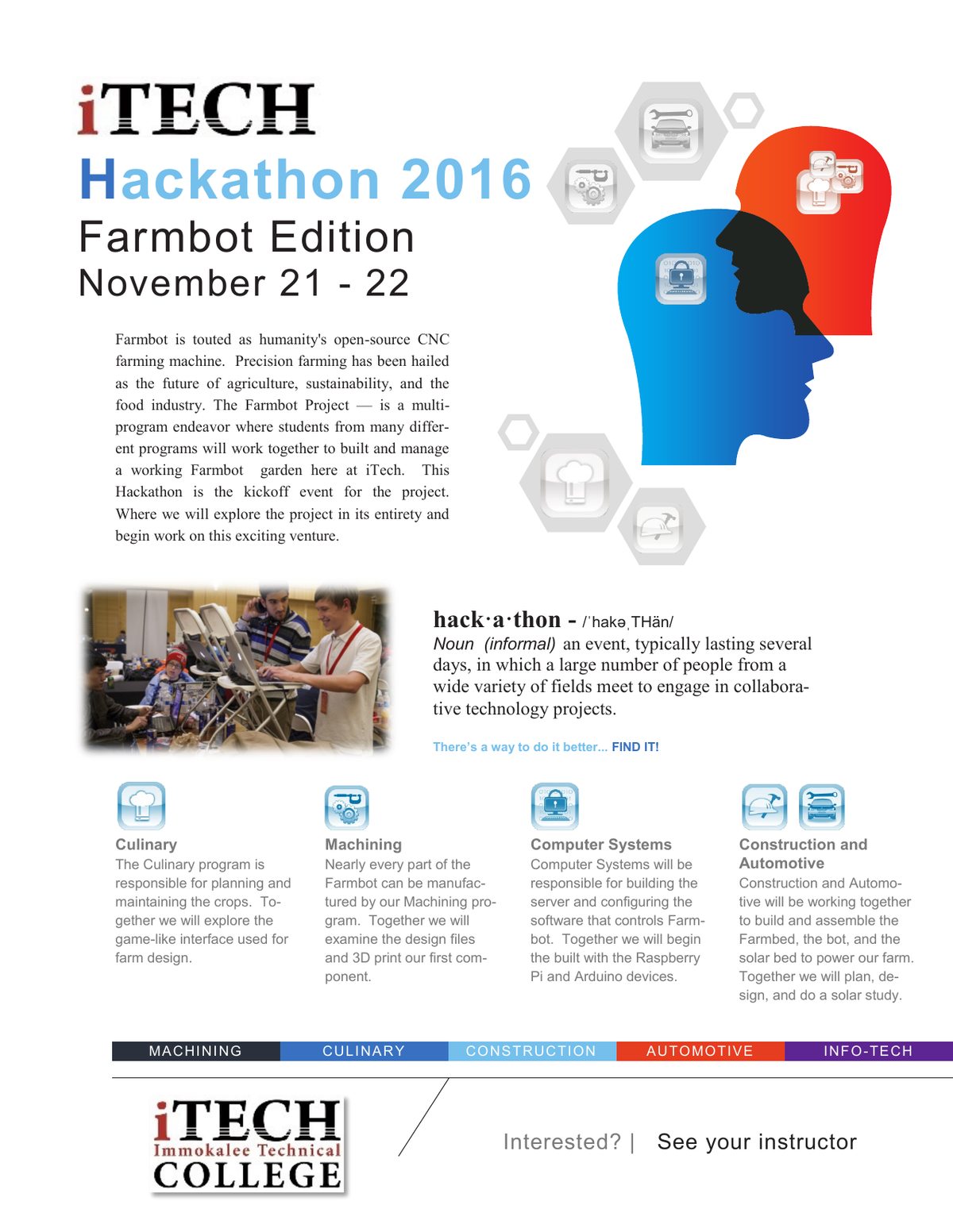
iTech Hackathon 2016: FarmBot Edition
Immokalee Technical College · November 21–22, 2016 · Funded by a Champions for Learning classroom grant
The idea
FarmBot is an open-source CNC farming machine — precision agriculture at garden scale, driven by a Raspberry Pi and Arduino boards. I wanted one in the iTech courtyard, built by students.
The interesting constraint was that no single program could build it. The machine needs precision-machined parts, 3D-printed components, a raised bed, a solar and rainwater system, and someone who actually knows what to plant. That’s five trades. So instead of running it as a Computer Systems project, I scoped it as a campus project and split the build:
| Program | Responsibility |
|---|---|
| Computer Systems | 3D-print components; server technology and electronics |
| Machining | CNC-manufacture precision parts |
| Construction | Design and build the raised farm bed |
| Automotive | Design the solar and rainwater collection systems |
| Culinary Arts | Plan the garden and select crops |
Over 150 students across those five programs were directly involved, on a campus of about 350.
Why a hackathon
The hard part of a cross-program project isn’t the engineering — it’s that students in five separate trades have no idea what the others contribute, and a year-long build gives them no reason to find out. A kickoff event solves that in two days.
I ran it as a hackathon: small mixed groups, parallel problem-solving, presentations at the end. Over the two days, groups rotated through:
- Choosing a site and performing a solar study
- Designing the farm bed and selecting crops
- Setting up the Raspberry Pi and Arduino boards that drive the robotics
- Building a project budget
- 3D-printing a FarmBot component
Monday opened with everyone together — what a FarmBot is, why we were building one, then team-building before the first block left. Tuesday afternoon, the groups built and delivered presentations of their work to each other.
The scheduling problem
This is the part I’d want to talk about in an interview, because it’s where the real design work was.
Technical college students don’t share a timetable. Dual-enrollment students arrive and leave on their own blocks, so at any given hour I had a different population in the room. And the activities were equipment-bound — one 3D printer, one set of Arduino boards, a limited number of stations.
So the event ran as a staggered round-robin rather than a schedule. Groups rotated through stations in an order that kept every piece of equipment occupied while absorbing students arriving and departing mid-event. Partial participation was designed in from the start, not accommodated after the fact.
That structure is the thing I reuse most. The AI Innovation Lab I’m building now is organized exactly the same way — equipment as stations, teams rotating through — because it’s the only format that survives a real CTE timetable.
What came of it
The hackathon launched the build. Through the fall semester each program produced its parts; in spring the trades assembled the machine and Computer Systems brought up the electronics and server side.
It also turned out to be a recruiting event I hadn’t planned. The district guidance office asked to bring prospective students to watch the opening and the final presentations — which says something about what two days of students visibly building a farming robot does for a program’s story.
Documentation
- Hackathon video
- FarmBot project announcement and grant — iTech CST blog, October 2016
- Hackathon announcement — October 2016
- Day one — November 2016
- iTech FarmBot project video