
Pizza Quality Control with Amazon Rekognition Custom Labels
M.S. Information Technology (Machine Learning focus), Florida State University — data analytics coursework, Fall 2021. Full write-up and console screenshots: github.com/amymcmullin/pizza-quality-control-aws-rekognition
A 48-second silent walkthrough of the build, cut from the original presentation slides and AWS console screenshots. The video was produced with AI assistance; the project, the screenshots and the analysis it summarizes are mine.
The project
The assignment was to pick a technology and teach the class how it works. Rather than read a feature list aloud, I took a published AWS customer case study and rebuilt the machine learning pipeline it described — in my own AWS account, with my own data, start to finish.
Maestro’s Pizza, a chain in Saudi Arabia, had put cameras in every branch to monitor pizza quality. Reviewing that footage took 13 full-time employees more than 10 hours a day, filling out checklists by hand. They had bought a data problem to solve a quality problem.
I rebuilt the classification half of their solution with Amazon Rekognition Custom Labels: images to S3, a five-label model trained on 24 images (Good, Bad, Pepperoni, Supreme, White), evaluation, and deployment via the Rekognition API.
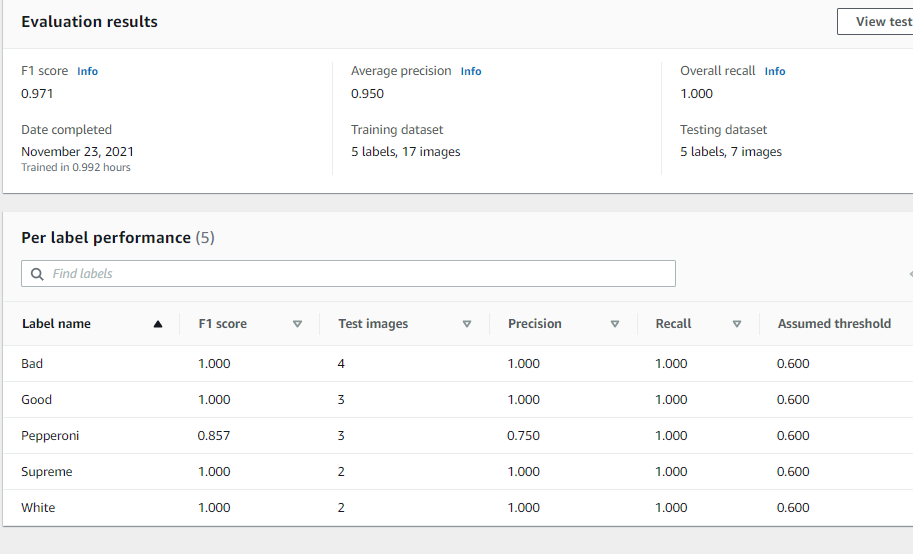
Results: F1 0.971 · average precision 0.950 · overall recall 1.000 · trained in 0.992 hours.
Why that number doesn’t mean what it looks like
The most useful part of this project was not getting a good score. It was working out why the score was not trustworthy:
- The test set is seven images. One misclassification moves F1 by about a tenth. This is a smoke test, not a generalization estimate.
- The training data is out of domain. My images came from web search — studio lighting, centered framing. Maestro’s come from a fixed camera over a prep counter, with glare, hands, and occlusion. Domain mismatch is the most likely reason a project like this fails in production, and my rebuild has it in full.
- “Bad” was never operationally defined. I labeled by instinct. A production system needs a written rubric and a measure of agreement between raters before labeling starts.
- Cost is billed by inference hour, not by call — so the architecture decision that actually matters for the budget is batch versus always-on, and nothing in the ML workflow surfaces that for you.
What I took from it
AWS’s claim — that machine learning is now accessible without deep ML training — mostly holds. I deployed a working image classifier without writing a training loop. What AutoML does not remove is the judgment: defining labels, sourcing representative data, deciding which errors are expensive, and recognizing when a metric is flattering you.
Those are the parts I now spend the most time teaching. This project became the template for how I introduce applied machine learning at Immokalee Technical College: start from a real business problem, build the smallest working version, then interrogate your own results until you find where they break. It’s part of the curriculum behind iTECH’s AI Innovation Lab.