
iTech Differentiated OCP Tracker
LIS 5367, M.S. Information Technology, Florida State University — Summer 2021. Code, screenshots and full write-up: github.com/amymcmullin/itech-ocp-tracker
The problem
Florida’s career certificate programs are built around Occupational Completion Points. A student earns an industry credential by demonstrating mastery of a defined list of standards — not by accumulating seat time. The program I teach, Y100200 (Computer Systems & Information Technology), has four OCPs, 50 standards and 245 skills beneath them.
Tracking that on paper is miserable. A student halfway through has demonstrated some standards through coursework and others by doing live work around the building, with no clear view of what remains.
What I built
A PHP/MySQL web application over an 11-table normalized schema that does three things:
- Shows a student their own progress — which standards they’ve mastered, at what level, and what’s left.
- Lets an instructor record skills observed during work-based activities, not just graded assignments. A student who struggles with a written test can demonstrate the same standard by installing a workstation, and it counts.
- Keeps assignments mapped to framework standards, so coursework and credential requirements stay connected.
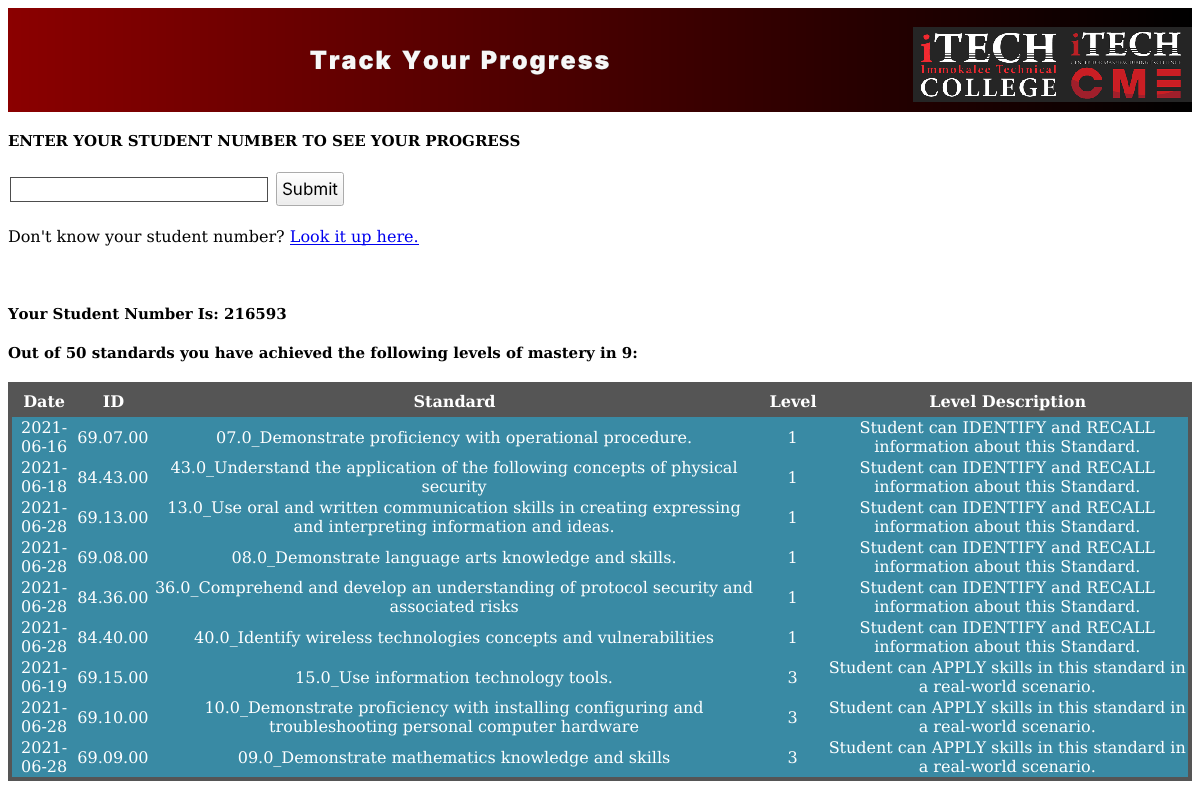
Mastery is recorded at four levels, from can identify and recall through can apply in a real-world scenario, so progress reads as a gradient rather than pass/fail.
I started it on a local Ubuntu LAMP VM, then migrated it to AWS — web server and PHP onto an EC2 instance, the database onto Amazon RDS — to decouple the application from its data. HTML, PHP, SQL and Git were all new to me at the time; I came from the infrastructure side.
The part I find more interesting now
I teach applied cybersecurity. Reading my own code back five years later is a useful exercise, so the repository includes an honest audit rather than a cleanup.
My original write-up already listed hardening as future work — input validation, SQL sanitization, access control, OAuth2 from Canvas. I even noted in the demo instructions that a real implementation wouldn’t let anonymous users look up student records. The gaps were visible to me then; I just couldn’t close them yet.
What I’d flag now, specifically: SQL injection in every query (user input interpolated straight into query strings), live database credentials committed to the repository, no authentication or authorization of any kind on records covered by FERPA, stored XSS in the observation notes, and random integers used as primary keys with no uniqueness check.
None of that is unusual for a first web application. Publishing it unedited is the point — the distance between “it works” and “it’s safe to put in front of real students” is exactly what I spend my time teaching now.
A note on the data
The original database held real student records — names from an actual cohort paired with skill-mastery data and observation notes. That dump is not published. The repository ships a de-identified seed with invented names, regenerated IDs and rewritten notes, with foreign keys remapped so the application behaves identically against it.