
SYSTEM LOCKDOWN: A Print-and-Play Escape Room
Immokalee Technical College · Computer Systems & Information Technology (Y100200) Print pack, generator and facilitator guide: github.com/amymcmullin/educational-escape-rooms
The constraint
I needed a week-one activity for a cohort I had not met, in a week with no lab access, for students who had been taught nothing yet. Most active-learning material assumes at least one of those three things.
So the design brief was narrow: it has to run entirely on paper, it has to work cold with zero prerequisite knowledge, and it has to tell me something useful about the people in the room.
What it is
A ransomware worm called BLACKOUT has locked a client’s server. Students are the incident response team. The client’s only IT tech quit two weeks ago and left four sealed envelopes and a locked recovery box.
| Play time | 45 minutes, plus ~10 briefing and ~20 debrief |
| Group size | Teams of 3–5; runs from 8 to 30 students |
| Prep | ~25 minutes of printing and cutting for six teams |
| Cost | Free with sealed envelopes; about $40 with combination locks |
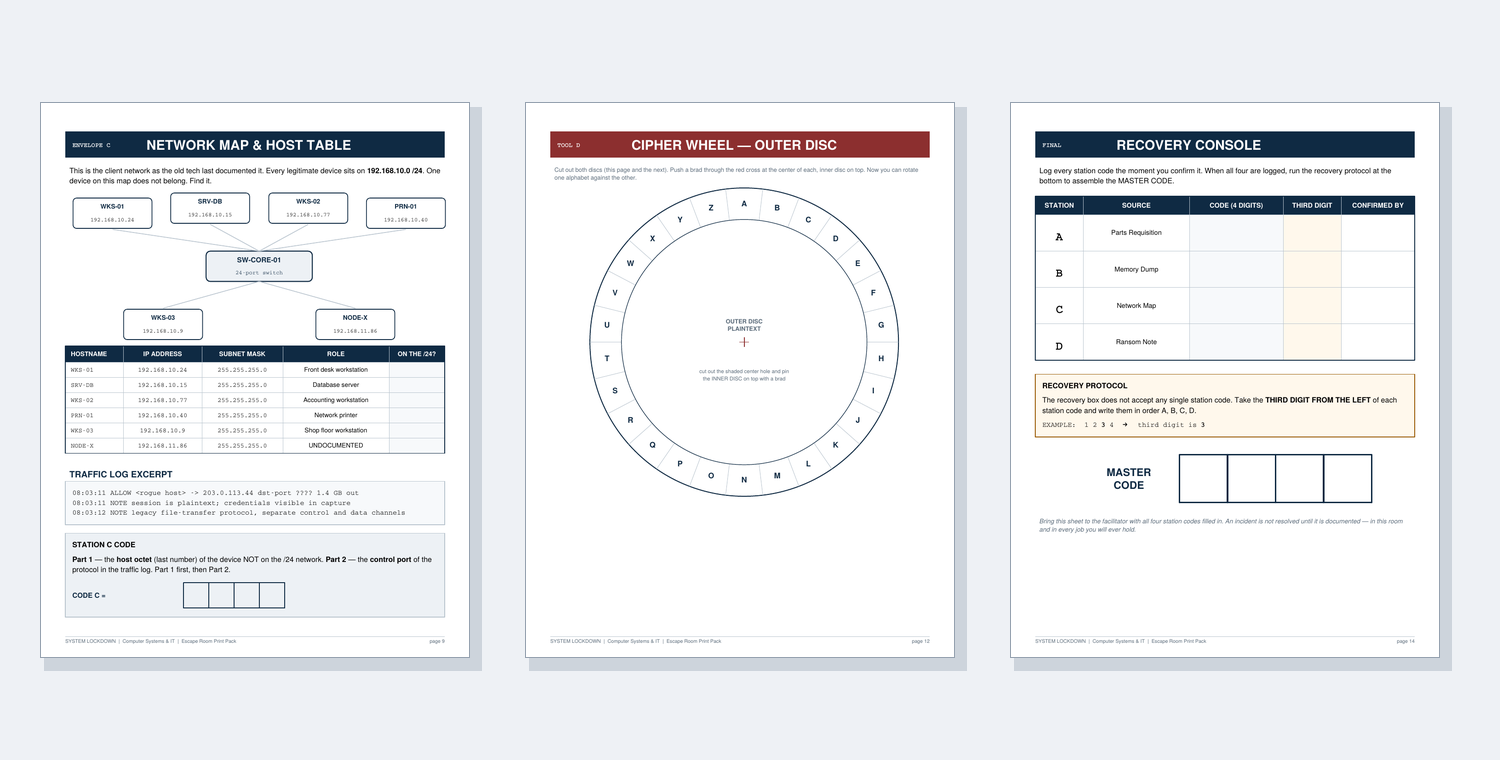
Each envelope holds one puzzle producing a four-digit station code:
| Station | Content | Employability skill on display |
|---|---|---|
| A — Parts Requisition | Match function descriptions to component cards; six of ten are decoys | Reading technical documentation for meaning |
| B — Memory Dump | Binary → decimal → ASCII; decodes to a recovery command | Precision, checking your own work |
| C — Network Map | Find the device off the /24, identify the protocol in the traffic log | Comparing data systematically |
| D — Ransom Note | Caesar cipher solved with a cut-out cipher wheel | Following a procedure exactly |
| Final | Third digit of each code, in order | Documentation and handoff |
The design decisions worth defending
The stations are parallel, not sequential. This is the structural choice the whole activity rests on. Sequential puzzles mean one stuck team is stuck for the rest of the hour, and in practice one confident student solves everything while the others watch. Four independent envelopes means everyone is working at once, a quiet student can own a station, and the only bottleneck is the final code.
It runs cold, so it doubles as a diagnostic. Every reference card a student needs is inside the envelope — binary place values, an ASCII table, a subnet explainer, a ports table. Nothing is pre-taught. That means I can run it on day two and spend 45 minutes watching who reads the reference card versus who guesses, who writes things down unprompted, who checks a teammate’s arithmetic, who takes over and who disappears. That is better information about a new cohort than any icebreaker produces.
Documentation is a role, not an afterthought. One of the five role cards owns the Recovery Console worksheet, and nothing counts until it is written there. The debrief asks why. Real incident response is incomplete documentation, time pressure, and a team you barely know — the activity is shaped like the job.
Three delivery modes, because budgets differ. Physical combination locks give the best experience. Sealed envelopes with the code written on the outside cost nothing and keep the whole feel. A Google Form using regex response validation blocks a student from advancing until the code is right, so it behaves like a lock, works on phones with no lab, and timestamps every team’s progress.
There is an Easter egg. The master code is also the incident ticket number printed on the first page students read. Teams almost never notice. Revealing it at the end of the debrief makes a real point about how much information walks past an analyst unnoticed.
The problem with publishing it
Open-sourcing an answer key is self-defeating when your students can find your GitHub. I hit the same question with the AI Certification Diagnostic and solved it there by keeping the keys out of the repository.
That does not work here, because the generator source is the answer key — anyone reading the script sees the component ID digits and the binary values.
So the fix was to make the codes configurable instead. Every station answer is derived from a config block at the top of the generator: the component ID mapping, the word hidden in the memory dump, the rogue host octet and port, the cipher shift word and the ransom note plaintext. Change those, rebuild, and the puzzles, reference cards and prose all follow — the memory dump table even resizes if the recovery word is a different length. The build prints the resulting answer key to the terminal.
The published defaults are the ones in the facilitator guide. Any teacher using this, including me, regenerates before running it. That is a better outcome than hiding the key would have been: it makes the pack reusable across cohorts and genuinely adaptable by other programs.
Reuse
The shell outlasts the content. Station B can become subnetting practice once subnetting has been taught, Station C a Wireshark capture excerpt, Station D hash identification or a password policy audit. What should not change is the four-parallel-stations-plus-meta structure — that is the part that makes it work.
Everything is CC BY 4.0 for any CTE program that wants it.
Scenario design, content alignment and facilitation decisions are mine. The print pack generator and the facilitator guide were produced with AI assistance against that specification.