
OmniTech Arena
Immokalee Technical College (iTECH), Computer Systems & Information Technology (Y100200). Fall 2026. Games, evidence files, answer keys and tooling: github.com/amymcmullin/OmniTech-Arena
The problem
Capture-the-flag (CTF) competitions are one of the best ways to get students solving problems instead of memorizing, but nearly all of them are about offensive security. Most of my program isn’t. Y100200 covers help desk work, operating systems, networking, hardware, and security, and my students are preparing for certifications like Cisco’s CCST IT Support.
My classroom is also open entry. I teach two programs with five different start dates, so on any given day students are in very different places. A traditional timed CTF event doesn’t fit that. Students need games they can step into as soon as they finish a course module, whenever that is.
What I built
OmniTech Arena is a growing library of CTF games for CTFd, organized into tracks by subject. The first track follows the four courses of the Cisco Networking Academy IT Support Specialist path, one game per course:
| Game | Course | Challenges |
|---|---|---|
| First Shift | IT Customer Support Basics | 33 |
| Second Shift | Operating Systems Support | 37 |
| Third Shift | Security and Connectivity Support | 44 |
| Final Shift | Hardware and Upgrade Support | 39 |
Students play a technician at Sawgrass Logistics, a fictional company, and get promoted shift by shift from Tier 1 help desk to hardware and upgrade support. Every challenge is a ticket with evidence attached:
- a ticket queue export to calculate SLA breaches and first-contact resolution from
- call transcripts where students identify customer types and bad hold-and-transfer technique
- a domain controller security log with one locked-out account to find
ipconfig,tracertandnetstatoutput to read like a technician would- a phishing email whose link text doesn’t match where it really goes
- a Linux lab pack that students extract and investigate inside the VM they build in the course
Each game ends with a boss ticket that unlocks after related challenges and chains several files together. In one, students follow a phishing campaign through the proxy log to the single PC that got through. In another, they recover a CFO’s BitLocker key when her laptop has two keys and another laptop’s key ID looks almost the same as hers.
Design decisions
- Evidence over trivia. Most flags come from analyzing a file, not recalling a definition. Pure recall is limited to short warm-ups.
- Aligned to two frameworks. Every challenge is tagged with its CCST IT Support objective and, where it fits, a Y100200 standard. Answer keys cite the course module and slide each answer comes from.
- Hard to guess, easy to answer. Multiple-choice and letter-sequence answers are shuffled and attempt-limited. Flags accept reasonable formatting, so
INC-10408and10408both work. - Always open. All four games stay on one server all year, grouped by category prefix. Students start each one as soon as they finish the matching course, and scoreboard brackets separate cohorts so each group competes among themselves.
- Built with AI assistance. The 153 challenges and their evidence files were generated against the specification above, then tested end to end before students played them. The track structure, the Sawgrass Logistics scenario, the evidence-over-trivia principle, the dual-framework alignment and the QA pass are mine.
- Tested before students saw it. Every game was loaded into a test server alongside the others. A test account then submitted every correct answer and a set of wrong ones. Evidence files are generated by scripts, so each game can be rebuilt or varied for a new semester.
First results
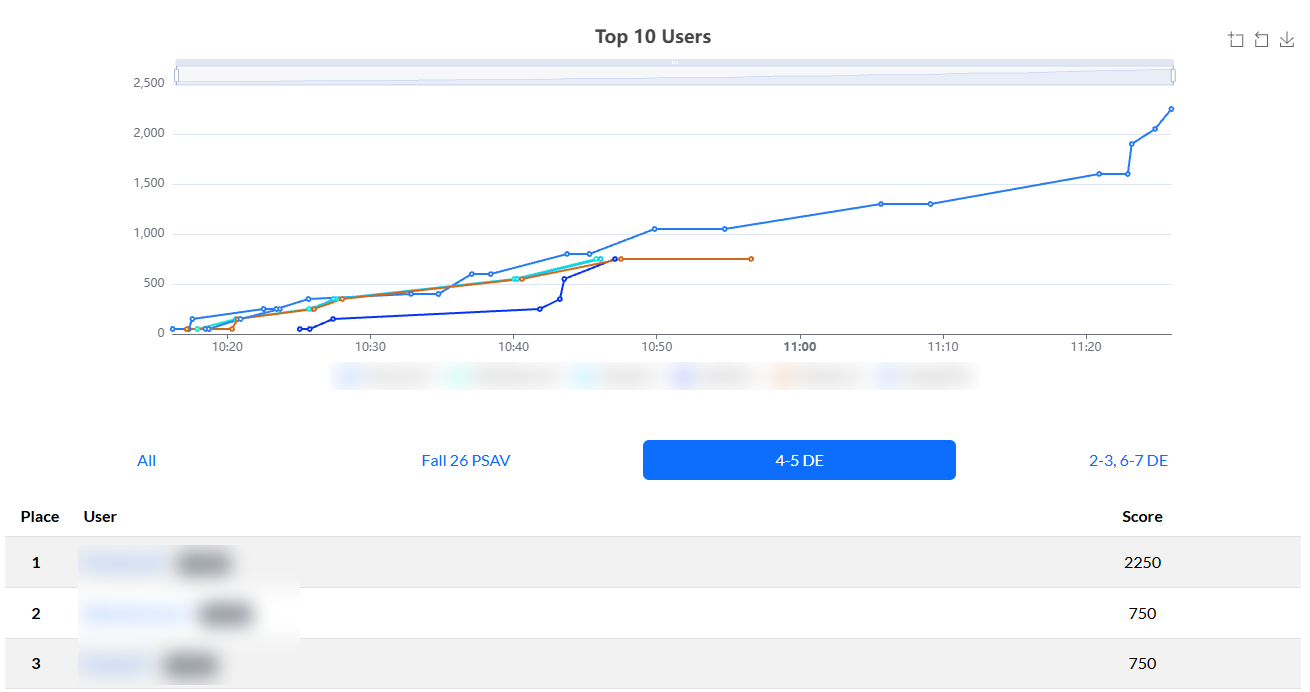
In the first session, the top student in one cohort passed 2,250 points in about an hour.
What I learned running it
Some of the most useful lessons were about the platform, and they’re written up in the repository so other teachers can skip them:
- Restoring a CTFd backup from a different version can fail partway through and leave the database broken. Loading games through the API is safer, and it never overwrites what’s already there.
- Newer CTFd “Modules” don’t give students a menu to pick from. Challenges in a module are simply hidden until an admin unlocks them for a student group.
- Once any scoreboard bracket exists, CTFd makes every student pick one before they can continue.
What’s next
More tracks will be added as the program covers more subjects. Everything is open source for any CTE program that wants to use or adapt it.